Let's be completely honest: if you are still building Google Ads campaigns the way you did two or three years ago, you are actively burning your budget.
If your daily marketing routine still revolves around obsessing over exact-match keywords, manually swapping out ad copy, and trying to outsmart search terms, you are playing an old game. The rules did not just bend over the last couple of years: the entire board was reset around AI.
This is not about chasing shiny new features. It is about accepting how Google's advertising platform has fundamentally rebuilt itself. If you do not adapt, you are not just falling behind; you are losing ground to competitors who have accepted the new reality.
At Kozan, we manage performance campaigns for DTC brands, healthcare clinics, and aviation businesses across the US. We have a front-row seat to this shift. (For a look at how we run our managed Search and Performance Max campaigns, check out our Google Ads management services).
Here is exactly what we are seeing on the ground in 2026, and exactly what we are doing about it to keep our clients profitable.
Table of Contents
- The Reality Check: The Keyword is No Longer King
- What Actually Changed This Year?
- The 2026 "Power Pack" Architecture
- How to Rewrite Your Playbook Today
- What Google Ads Looks Like for Your Industry
- Your Action Checklist
- The Bottom Line
- Frequently Asked Questions
The Reality Check: The Keyword is No Longer King
For a long time, winning at Google Ads was simple: find the right terms, build tight ad groups, write tailored copy, and bid aggressively on what converted. It rewarded manual control and endless tweaking.
That model is dead.
Think of Google Ads in 2026 like a self-driving Tesla. You do not need to steer or constantly pump the pedals (keywords and manual bidding). Instead, your job is to tell the car exactly where you want to go (conversion goals) and keep the cameras and sensors clean (data quality).
If you feed the system dirty data, it is going to drive your budget straight into a wall.
The Hard Numbers for 2026
- 62% of all Google Ads clicks now flow through Performance Max campaigns.
- We are seeing a 19% average increase in conversions when accounts successfully adopt AI Max with Smart Bidding.
- Keyword-free Search campaigns are no longer a beta test: they are a core feature.
- Call-only ads are on the way out. New creations were blocked in February 2026, and existing ones will stop serving entirely by February 2027.
What Actually Changed This Year?
1. AI Max: Keyword-Free Search Is Here
The biggest shock for search marketers this year is AI Max for Search.
For our major North American accounts, we are running campaigns with absolutely zero keywords. The setup is almost disarmingly simple. You give Google three things:
- A landing page URL
- A daily budget
- A target ROAS or CPA
The AI handles the rest. It analyzes your landing page, matches user intent, and writes headlines and descriptions on the fly to match what the searcher is looking for.
- Where it wins: It is incredibly efficient for B2B services, lead generation, and finding high-intent buyers we never would have discovered with traditional keyword research.
- Where to be careful: If you operate in a highly regulated space (like healthcare or finance), you must set up strict Text Guidelines before enabling AI Max. Otherwise, the AI writes freely, which is a massive compliance risk.
2. Performance Max Is No Longer a Black Box
When Performance Max first launched, we hated it because we could not see what was happening under the hood. Fortunately, Google has finally opened up the dashboard. In 2026, we actually have real control:
- Channel-Level Reports: See exactly how much budget went to YouTube vs. Search vs. Display vs. Gmail.
- Asset-Level Insights: Know which specific image or video is driving actual revenue.
- Brand Exclusions: Stop PMax from bidding on your organic brand name and artificially inflating its own performance.
- Campaign-Level Negatives: We can finally apply negative keyword lists directly to PMax.
(If you want to see how to leverage these tools, check out Google's official Performance Max guide.)
🛠️ The 2026 "Power Pack" Architecture
At Kozan, we have retired the old, scattered campaign structures. For most of our clients, we now consolidate everything into a simple, three-part system we call the Power Pack:
Step 1: Performance Max (The Engine)
- Role: Broad, multi-channel reach across YouTube, Search, Maps, and Gmail.
- E-Commerce Budget: 60% to 70%
- Services & Leads Budget: 30% to 40%
- Note: Requires heavy visual assets and a flawless product feed to work well.
Step 2: AI Max for Search (The Sniper)
- Role: High-intent Search coverage. It targets the intent of the searcher, not just the exact keywords.
- E-Commerce Budget: 30% to 40%
- Services & Leads Budget: 60% to 70%
- Note: For service businesses, lead quality matters more than volume. Put your main budget here.
Step 3: Demand Gen (The Handshake)
- Role: Building awareness and demand on YouTube, Discover, and Gmail.
- Budget: Remaining balance
- Note: This warms up cold audiences so they recognize your brand when they search.
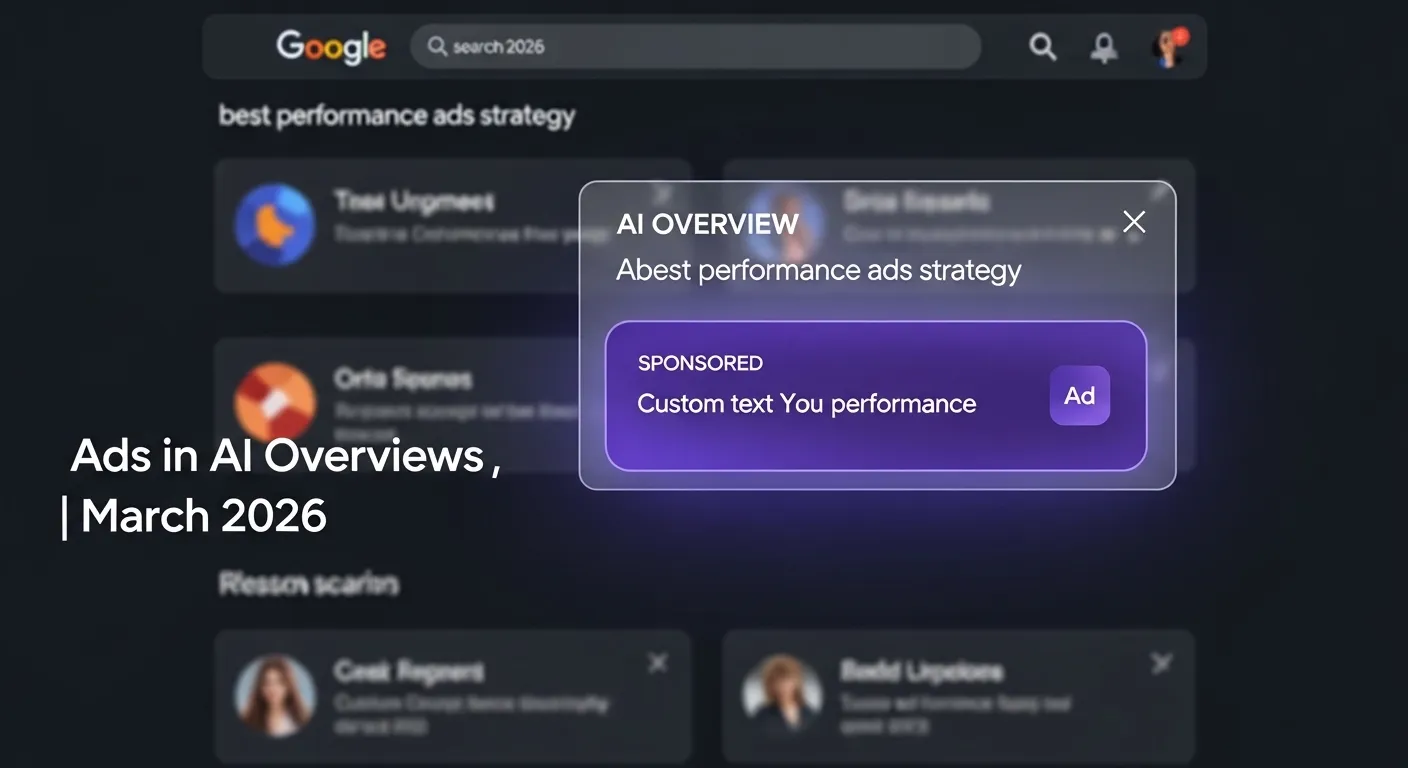
Ads Are Inside AI Overviews Now
Google's AI Overviews, the conversational, AI-generated answer blocks at the top of search results, are fully monetized. Your ads are now eligible to appear right within these summaries.
This means your paid and organic strategies must talk to each other. Brands that coordinate their paid search with their organic SEO are absolutely dominating this new, premium real estate.
How to Rewrite Your Playbook Today
Stop trying to outsmart the algorithm and start feeding it better fuel.
1. Feed the Machine Clean Data
If your conversion tracking is messy, the AI will spend your budget optimizing for junk traffic. You need to clean up your data infrastructure immediately.
- Implement Enhanced Conversions to match user data accurately.
- Sync your CRM directly back to Google Ads so the AI knows the difference between a cheap form-fill and an actual closed sale.
- Use proper campaign tracking from day one -- our UTM Link Builder generates GA4-ready URLs with all five standard parameters and channel presets.
- Not sure if your tracking is solid? Run our free Digital Marketing Scorecard for a 2-minute health check.
- Struggling with attribution? Read our guide on why GA4 shows inflated direct traffic and how to fix it.
2. Treat Creative Like Your Main Targeting Lever
In 2026, your ad creative is your targeting. Because Google's AI decides where to place the ads, your images and videos are what actually qualify the buyer.
- Ditch the stock photos. Use high-resolution lifestyle imagery that feels authentic.
- Stop letting Google auto-generate your videos. They look generic and perform poorly. Invest in custom 6-to-15-second vertical videos built specifically for PMax.
- Watch your Ad Strength scores. This is your primary campaign health metric today.
(At Kozan, our creative team builds Performance Max-optimized asset packages as a standard part of our advertising engagements.)
What Google Ads Looks Like for Your Industry
🏪 DTC E-Commerce
Performance Max is your primary driver. But if you're running it with the same product feed and creative assets you used in 2023, you are leaving massive profit on the table.
- Action: Use our free ROAS calculator to benchmark your current returns against your industry peers.
- Learn more: See our DTC E-Commerce SEO services
🏥 Healthcare Clinics
AI Max is the ultimate tool here. Pair compliance-safe Text Guidelines with CRM-connected signals to book qualified appointments at scale without the compliance headache.
- Action: Set up Text Guidelines on day one to keep your AI-generated ad copy fully compliant with local medical regulations.
- Learn more: See our Performance Advertising services
✈️ Aviation Services
Aviation is a high-ticket, trust-first business. We run AI Max with strict brand exclusions and Customer Match lists. This prioritizes ultra-qualified, low-volume inquiries over cheap, low-intent clicks.
- Action: Focus on deep, custom landing pages tailored specifically to your core services.
- Learn more: See our Google Ads Management services
Your Action Checklist
Before you spend another dollar today, run through this quick list:
- Audit your tracking: Are GTM, GA4, and your CRM communicating cleanly?
- Turn on Enhanced Conversions: Give the AI the matching data it needs.
- Upload offline data: Sync your customer lists as Customer Match signals to guide the AI.
- Check your Call-only ads: These stop serving entirely in February 2027. Transition them to Responsive Search Ads (RSAs) with Call Assets.
- Review your PMax video assets: Replace any auto-generated slideshows with custom, high-quality video.
- Configure Text Guidelines: Essential if you are in healthcare, finance, or a regulated space.
- Audit your ad scheduling: Use our free Ad Timing Optimizer to find your high-ROAS windows and cut wasted spend on dead hours.
The Bottom Line
Google Ads in 2026 rewards advertisers who understand that automation is not the strategy: it is the environment in which your strategy operates.
Our job as marketers has changed. We are no longer keyword managers; we are data governors and creative directors. The brands that feed the machine the best data, the cleanest signals, and the most compelling creative are the ones winning the auction.
The platform has changed. The only question is: has your strategy?
If you're not sure where your campaigns stand, request a free, no-strings-attached revenue risk assessment from our team. We'll show you exactly where the gaps are.
Frequently Asked Questions
What is AI Max for Search?
It is a keyword-free Search campaign. You provide a landing page, a daily budget, and a ROAS or CPA goal, and Google's AI automatically handles the intent targeting and ad copy creation.
When will Call-only ads end, and what should I use instead?
New Call-only ads cannot be created as of February 2026, and existing campaigns will stop serving completely by February 2027. You should transition to Responsive Search Ads (RSAs) with Call Assets so Google can optimize when to show a click-to-call versus a landing page visit.
How do I control brand voice and prevent off-brand AI ad copy?
Use the Text Guidelines feature in Google Ads. You can set term exclusions, brand safety rules, and messaging restrictions (words or claims to avoid) so the AI-generated headlines stay completely on-brand, which is incredibly critical for healthcare and finance.
Will my ads show up in Google's AI Overviews?
Yes. Ads are now eligible to appear above, below, or directly inside AI-generated answer blocks based on search relevance, auction dynamics, and how well your landing page satisfies the search intent.
Is Performance Max right for every business?
Not necessarily. Performance Max works best when you have a strong product feed, healthy conversion volumes, and high-quality creative assets. Many service and B2B brands find much better success prioritizing AI Max for Search, where lead quality is prioritized over raw traffic volume.
Should I turn off manual bidding entirely in 2026?
Not immediately, but you should be testing automated bidding strategies against your manual campaigns now. Google's AI-driven bidding has closed most of the performance gap for accounts with sufficient conversion volume, and the platform increasingly optimizes its interface and support around automated strategies. Accounts with low conversion volume may still see better control with manual bidding for now.
How much budget do I need for AI Max to work well?
There is no strict minimum, but AI Max needs enough daily budget and conversion volume for Google's algorithm to gather meaningful signal quickly. Very small budgets take longer to optimize since the system has fewer data points to learn from. Most advertisers see the algorithm stabilize within two to three weeks once budget and tracking are set up correctly.
Can I still exclude specific competitors or unwanted search terms in AI Max?
Yes, though the controls work differently than traditional negative keywords. Brand exclusions and term exclusions inside Text Guidelines let you block specific competitor names or unwanted phrases from triggering your ads or appearing in AI-generated copy. It is less granular than manual negative keyword lists but still gives meaningful control over where your budget shows up.
Ready to modernize your campaigns? Book a strategy call with our team, explore our performance advertising services, or get in touch to see how we can help you transition your accounts.

